Saturday, November 25, 2006
Netflix
Wings of Desire is something special. Angels move around a sepia-toned Berlin, listening to humans' thoughts. Occasionally the angels touch people when they are particularly moved, but only the very old, the frail, or the mad seem to notice these caresses. Oh, and the actor Peter Falk is aware of the angels too, for reasons I won't disclose.
I thought it magnificent and dreamy, like a masterpiece of German Expressionism with the light touches of a romantic comedy at the finale. Like Falk tells one of the angels: coffee is great, as is a cigarette, and rubbing your hands together when they're cold feels magnificent. People don't notice how wonderful these things are anymore, however, trapped in their interior monologues, their endless catalogues of personal suffering and doubt. The eternal angels envy us and we can't understand why.


Wednesday, November 22, 2006
Mary Henderson
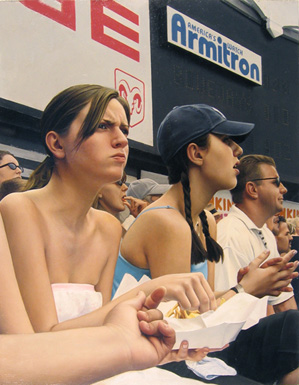
My second-favorite periodical, Harper's, often features interesting paintings by relatively unknown artists. This month they have Dinner Table by Mary Henderson (her painting Baseball Game is above).
I find her work very striking. There's a clash between what I regard as painfully banal subject matter and a truly masterful technique, and the void left betwixt these two opposing forces I fill in with my own experience as a college professor and a long-time sufferer of neighborhood frat and sorority shenanigans. I'm both drawn to and repulsed by these paintings as a result. According to James Joyce's aesthetic theory, Mary Henderson's work is therefore pornographic.
Netflix
Troubled by some awkward cuts in this intriguing film, I checked around and found out that Disney chopped the theatrical release from 123 minutes down to 105 for no apparent reason. I can't say much about Like Water for Chocolate as a consequence, because I can only speculate about its full original effect. The 105-minute version is too jumpy and clumsy, but there are dreamy languid sequences that perhaps hint at the original pacing. I was reminded of a Telemundo soap opera, but with lots of magical realism. The mother is cartoonishly awful (¿cómo usted dice no more wire hangers en español?), and there are many very sexy touches (including an acrobatic redhead riding a revolutionary guerrilla cowgirl style while on horseback). Didn't expect the, uh ur--fiery climax at all.
Perhaps somebody will do a more complete DVD release, using a less murky transfer. Still worth seeing in its present frenetic state.
Tuesday, November 21, 2006
#89
Reading Raymond Carver affects my vernacular. I begin thinking and speaking in a folksy clipped manner. All words worth more than a nickel vanish from my vocabulary. This phenomenon happens with TV shows regularly (when I watch 2 episodes of The Wire per day for a week, for example, I'll start to say muthafucka and sheeyit and bitch more often). But typically what I'm reading doesn't change how I speak. I don't coil my verbiage with endlessly looping dependent clauses when I'm reading Henry James, for instance.
But Carver's simplicity is deceptive, as they say. You can read one of his sad tales of loss and the losers who experience it in a straigtforward manner, enjoy the story and mark its lack of pretense, and miss completely its surprising depths. This collection has several stories I've read before: "A Small Good Thing" can still bring a tear to my jaded eye after a half-dozen re-visits; "Cathedral" insists that we're all blind and unable to communicate; "What We Talk About When We Talk About Love" discusses darkly the greatest mystery humans face; and, of course, there's the title story, which I've taught to hundreds of undergrads,and which still knocks me for a loop. I find more symbolism in "Where I'm Calling From" each time I read it, and each time I think How in God's name could I have missed that all these years?
I missed that because Carver is a true master of the form, and his gift for subtle, simple imagery may be unmatched. All those references to fires, hearths, flames, chimneys, chimney sweeps, and wells in the title story? They add up to an impressionist masterpiece, and there are several in this volume.
Monday, November 20, 2006
Netflix
I saw truly terrible trailers for this back in 1999, and refused to see it as a result. Just goes to show how foolish some marketing folk are, because The Iron Giant is an excellent animated film--easily on a par with The Triplets of Belleville or Miyazake's stuff. I laughed out lout several times as US Cold War propaganda was ably lampooned, and there's a scene with a freaky beatnik in a lawnchair that cracked me up. Features quelques hommages to Bambi and The Day the Earth Stood Still, which are seamlessly woven into the story. Beautifully animated to boot. I might break my self-imposed no-DVD-purchasing ban for this one. Kudos to Faulty Landscape for the recommendation.
Saturday, November 18, 2006
Junques
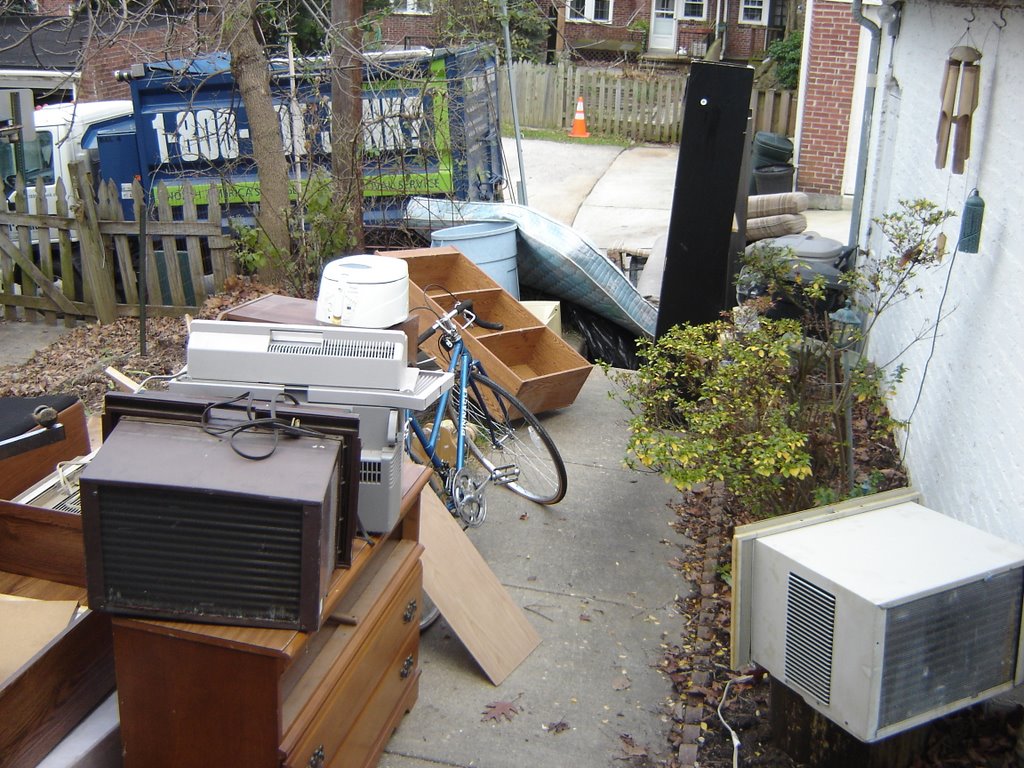 Today while Cha was at her graduate class at George Mason I took the liberty of inviting the 1-800-Got Junk? boys over for a visit. Aside from breaking a window in our basement door, they did a great job. I feel immeasurably better.
Before the junk men came Cha put some stuff on Craig's List, and people took away old dumbells, a desk, and some crappy Caldor book cases.

Friday, November 17, 2006
#88
Why wasn't God watching?
Why wasn't God listening?
Why wasn't God there?
Tom Waits
The Year of Magical Thinking is a horrible book. By the descriptive 'horrible' I don't mean in any way to impugn the quality of the book, which--like others Didions I've read--is sharply honed, elegantly reasoned, and deeply sincere. I'm rather describing with 'horrible' the events narrated in this memoir of suffering, of grief and mourning.
I recall near the culmination of the national fiasco known as the Schiavo Affair reading in the New York Review of Books an essay by Joan Didion about the case. I recall an unexpected turn in the essay's last third, wherein Didion was surprisingly sympathetic to the Schindler family stand, and in which she was deeply hostile to Michael Schiavo, to the point of re-hashing some rightwing claptrap about his motives, and even suggesting he was not wholly innocent in Terri's original injury. I'd of course long had my opinions about the Schiavo Situation, and finding an intellect I typically admire--and in a periodical with which I'm typically ideologically aligned--suggesting that I was entirely wrong was, to say the least, troubling. I remember thinking that if Joan Didion really thought Michael Schiavo had hurt Terri then perhaps I'd completely misread the entire national soap opera.
But I remained adamantly against the government's intrusion in the case, and simply shrugged off Didion's position as a quirk. I can disagree with my idols and continue admiring them.
Now that I've read The Year of Magical Thinking, and glimpsed in her own words what Joan Didion and her family had experienced shortly before Schiavo unfolded, I can understand more fully her attitude that Schiavo should be kept 'alive' by any means necessary for the sake of her parents. I doubt with distance from her own immediately successive family traumas that Joan Didion would still maintain a similar stance in a similar situation, but given her experience I can certainly see her point of view, and can appreciate with more compassion the 'magical' thinking to which the Schindlers fell victim.
Ricky don't lose that number

Santorum's decision robs us of a The Handmaid's Tale
 future.* Ironic that Rick cites his wife as threatening to "throw him out the window" if he ran, making the decision easy for him.
Ofrick has more clout than I thought.
*I can't link to the LiveJournal I stole this reference from--it's a long story.
Subscribe to:
Comments (Atom)